

European Global

PROGRAMS

BBA in Tourism and Hospitality Management

Bachelor of Business Administration in Tourism and Hospitality Management

The Bachelor of Business Administration in Tourism and Hospitality at European Global Institute of Innovation and Technology EU Global is a 180 ECTS European Qualifications Framework EQF Level 6 Bachelor degree programme accredited by the Malta Further and Higher Education Authority MFHEA and globally recognised.

The programme equips learners with essential knowledge in tourism and hospitality covering travel management event planning hotel operations customer service destination marketing sustainability practices and strategic decision making. Students develop analytical ethical and professional competencies applicable across global tourism and hospitality business environments.

EU Global accepts Recognition of Prior Learning RPL and credit transfer based on learning outcomes enabling advanced entry or module exemptions for accelerated progression. Students may also exit with recognised intermediate qualifications at 60 or 120 ECTS.

Build Expertise for Global Tourism and Hospitality Careers

Bachelor of Business Administration in Tourism and Hospitality | EQF Level 6
180 ECTS • Online • Evidence-Based Learning

APPLY NOW

Programme Accreditation & Recognition

EU Global BA Tourism and Hospitality Management

Programme Overview

The Bachelor of Arts in Tourism and Hospitality Management provides students with a comprehensive understanding of the tourism and hospitality industries. The programme covers key areas such as travel management event planning hotel operations and customer service. Read More

Mode:Online
Application Due:Ongoing
ECTS Credits:180
Language:English
EQF Level:Level 6
Teaching:Online Teaching
Curriculum And Structure

EU Global follows a few unique concepts for teaching its Business students:

  • Evidence-based Management
  • Reflective writing
  • Research and Academic Coaching
  • Professional Coaching

Programme begins with Period 0, followed by modular learning.

Exit Awards / Qualifications

After completion of 60 or 120 ECTS, learners may exit with:

Undergraduate Higher Diploma in Tourism and Hospitality Management (EQF Level 5 – 120 ECTS)

Assessments

Includes formative and summative assessments.

End-of-module assessment is report based.

Grading system available via Quality Policies.

Target Learners Age

Ages 16 – 30

Ages 31 – 65

Boost your portfolio with Evidence-based Learning

EU Global unique teaching Andragogy of evidence-based management allows learners to practice, recommend and reflect for continuous growth.

EU Global provides following in addition to the content:

  • Research Residency
  • Entrepreneurship Residency
  • Professional Coaching
  • Academic Coaching
  • 1:1 Project Mentor

Make the best of your Business Studies!
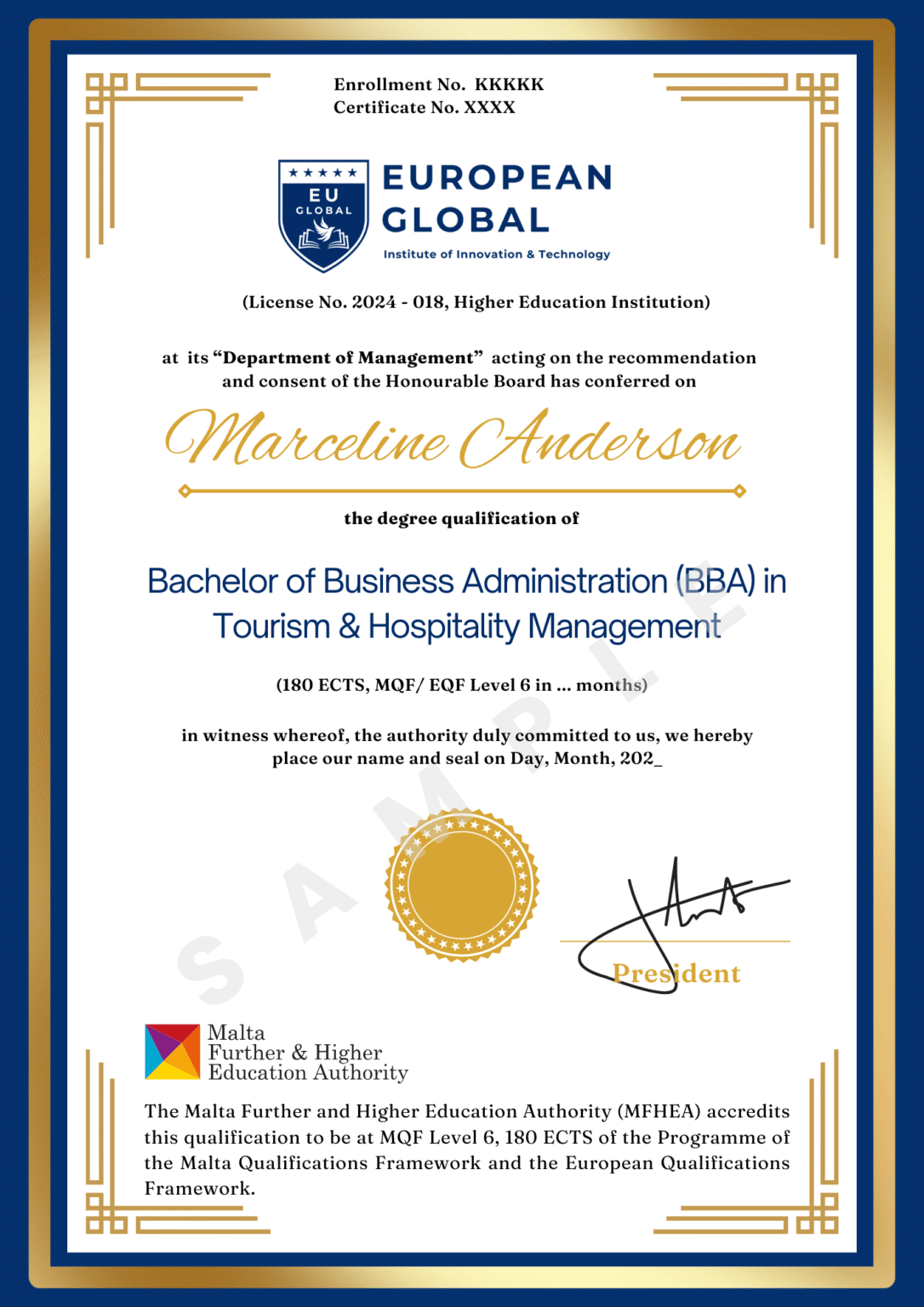
EU Global Degree Certificate

Programme Structure

Structured across three progressive years

Year 1

Milestone 1: Foundation & core business skills

Set the base to learn the best of your MBA!

  • Know employability skills & ways to develop it
  • Learn the “Reflective” way
  • How to reach the desired level of outcomes
  • Data Analysis using MS Excel
  • Develop LinkedIn Profile
  • Academic Writing

The Understanding Business and Management module provides a foundational exploration of what constitutes a business, the different types of business organisations, and key management concepts. It equips learners with a comprehensive understanding of how businesses operate within broader societal, environmental, and ethical contexts. The module also covers essential business functions, external environmental factors, organisational structure and culture, and the strategic role of SWOT analysis in business decision-making.

The Accounting for Business module is designed to provide learners with a comprehensive understanding of accounting and finance concepts within a business context. This module introduces students to the principles and practices of financial accounting, focusing on the preparation, analysis, and interpretation of financial statements. Students will learn about the key legal forms of business, the regulatory environment of the accounting profession, and the needs of financial stakeholders. Additionally, the module covers essential tools and techniques for assessing financial performance and planning.

This module aims to provide learners with a comprehensive understanding of the economic systems, financial markets, and their impact on global business. This course delves into essential economic concepts such as supply and demand, fiscal and monetary policies, market structures, and government-business relations. Learners will also explore different economic systems and their effects on global business operations. Through real-world case studies, students will develop the analytical and critical thinking skills necessary to navigate complex global business environments.

This module provides learners with a comprehensive understanding of Human Resource Management (HRM), focusing on the evolving role of HR in business strategy and operations. It covers the fundamentals of staffing, employee compensation, talent management, and workforce planning. The module explores how HR strategies align with overall business goals, along with emerging trends such as technology’s impact on recruitment, performance management, and employee engagement. Students will also examine employment law compliance, diversity and inclusion practices, and the strategic role of HR in organisational development. Practical case studies and real-world applications will be used to build essential skills in HR forecasting, talent development, and employee engagement.

In today’s data-driven world, effective business decision-making relies heavily on the ability to gather, analyse, and interpret data. This module equips learners with the knowledge and skills needed to leverage data for strategic decision-making. The course introduces fundamental concepts of data analytics, data management, and the use of statistical tools and technologies to extract valuable insights from business data.

Students will learn how to apply data analysis techniques to solve real-world business problems and enhance operational, financial, and marketing decisions. Emphasis is placed on understanding the role of data in shaping business strategies, optimising performance, and driving innovation. The module also covers ethical considerations in data usage, data visualisation techniques, and effective communication of insights to stakeholders.

This course is a language and content integrated module. Students develop the language they use in achieving learning objectives and develop a deeper understanding of topics, concepts, and theories that they will study and use throughout the qualification.

A thorough understanding of the theoretical and work-based knowledge relevant to the application of business management in theory and practice.

The ability to reflect on experience of business management practices to produce and apply new understanding and skills.

Year 2

Milestone 2: Applied management & tourism/hospitality focus

The Innovation and Entrepreneurship module explores the dynamic role of innovation and entrepreneurship in driving business growth and economic development. Students learn how innovative ideas are developed, transformed into viable business ventures, and managed for long-term success, with emphasis on opportunity recognition, entrepreneurial mindset, and risk/reward.

This module equips students with the knowledge and skills required to manage and improve operations and service delivery. It covers principles, processes, and strategies involved in producing goods and delivering services, including process optimisation, quality management, integration with other business functions, and technology-enabled efficiency.

Learners understand accounting procedures, financial statements, and calculations through different methods. The module also explores managing income effectively at organisational and personal levels and considers current developments and competitive financial environments.

An in-depth introduction to the tourism and hospitality industry, its historical context, organisational structure, and contemporary challenges. Students explore inbound/outbound/domestic tourism, sector businesses (accommodation, restaurants, transport, travel agencies), key governing bodies and regulation, and the role of Destination Management Organisations (DMOs) in sustainability and competitiveness.

An exploration of sustainability in tourism and hospitality, including the history of sustainable development, SDGs, and key policies. Students analyse environmental, social, and economic impacts across destination types and examine destination management, CSR, sustainability initiatives, and frameworks for measuring success.

Focuses on building and sustaining customer relationships in tourism and hospitality. Topics include customer satisfaction measurement, complaint management, social media engagement, service culture development, digital strategies, performance indicators, feedback analysis, and quality management to create customer-centric organisations.

Year 3

Milestone 3: Strategy, technology, law & research

Examines sustainability, quality management, and ethical practices as foundations for long-term success, including globalisation, transnational practices, corporate social responsibility, and quality principles that build a sustainable and ethical business landscape.

Explores business strategy: how organisations analyse external environments and make strategic choices for positioning with customers and competitors. Covers perspectives on strategy, the strategy toolkit, collaborative case study application, implementation constraints, and alternative ways of understanding strategy.

Covers principles and practices of managing events, focusing on the relationship between events and tourism/hospitality. Includes event classification (MICE), venue selection, business benefits, impacts of global crises, and sustainability in event management.

Explores legal frameworks, policies, and planning processes shaping tourism at local, national, and international levels. Students examine stakeholder roles, tourism policy-making, links to environmental and cultural policy, and develop destination management planning skills for sustainable tourism development.

Examines emerging and existing technologies shaping tourism and hospitality: GDS, ICT, mobile and wireless systems, OTAs, immersive tech (XR/AR/VR), online marketing, social media, data protection, and the impact of technology on consumer behaviour and competitive advantage.

Develops independent research capability: formulate a research question, plan and execute research using appropriate techniques, conduct literature reviews, collect and analyse data, and present findings and evaluated outcomes in a business and management context.

Application And Contact

Have questions?

Call at +971 50 408 7219

OR

Email at info@euglobal-me.org

Apply Now