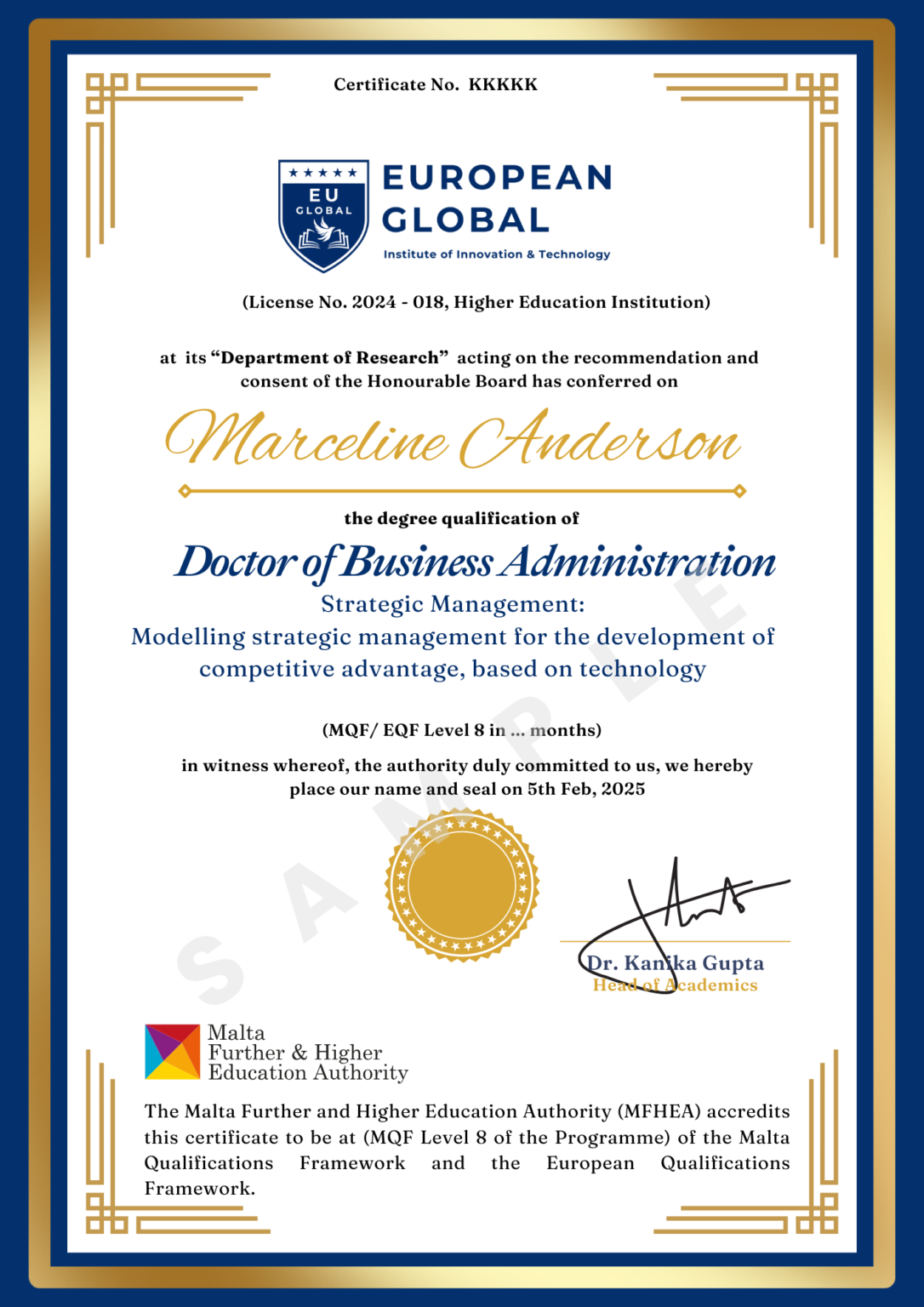

Doctorate of Business Administration (DBA)
European Global Institute of Innovation & Technology’s Doctor of Business Administration (DBA) is a European highest level qualification & is Malta Qualifications Framework (MQF) / European Qualifications Framework (EQF) full-degree Level 8 accredited Higher Education Programme and globally recognised programme. The degree offers right of use of “Dr” title.
EU Global accepts both experiential Recognition of Prior Learning (RPL) and credit transfer through the use of learning outcomes for either an advanced entry into the programme, or module exemptions for an advanced progression in a programme.
EU Global Online DBA Programmes can be taken in an accelerated mode (2 years), normal tenure (3 years) or part-time mode (upto 6 years).
Shape the Future of Business Through Doctoral Research
Doctor of Business Administration (DBA) | EQF Level 8 Applied Research • 180 ECTS • Flexible & Global
APPLY NOWProgramme Accreditation & Recognition












Programme Overview
The Doctorate of Business Administration (DBA) is at the highest level of the Malta Qualification Framework (MQF)/ European Qualifications Framework (EQF) Level 8 fully accredited degree programme. This doctorate qualification necessitates the primary focus of the candidate’s work to showcase an original.. Read More
Curriculum & Structure
EU Global Doctoral qualification is designed to strengthen scholars’ capabilities to create, plan, validate, execute, report on, and evaluate a significant research project that is professionally relevant and contributes to the generation of new knowledge. To achieve this, they should be able to structure and synthesise complex information, and adapt ethical practices in deciding methods of data collection and its analysis.The generic Doctoral program at EU Global will lead to “Dr.” Title. EU Global DBA is designed for those looking to apply research to practical business problems and advance in professional practice. DBA graduates typically pursue leadership roles in business, government, or non-profit organisations, such as CEO, CFO, COO, or other high-level executive positions. The program emphasises applied research that addresses real-world business challenges, often involving case studies and applied projects rather than purely theoretical work. DBA candidates develop advanced leadership, strategic, and decision-making skills, with a strong emphasis on professional development and networking opportunities with other high-level professionals.
The aforementioned outcome of application of management experience and generation of new knowledge with rigorous thesis of 60,000 words leads to the Qualification of Doctor of Business Administration (DBA) with “Dr ” Title conferment. EU Global’s DBA coursework is approximately 33% and the thesis is 67%, and scholars must defend the thesis successfully to be conferred DBA Qualification.
Exit Awards
Our strategic accreditation allows every learner to earn ECTS credits for every module they study. This allows students to take deferrals, exits and re-join studies and use same ECTS credits for an advanced entry into the programme.s.
For Doctorate of Business Administration interim exits, Master of Philosophy is awarded to those who complete the research coursework.
Assessments
DBA studies have coursework assessment and dissertation and defense, which should be related to solving a real business world problem.
The learners are required to write a dissertation of 60,000 words. Detailed guidelines on recommended chapters, supervisors coordination etc will be provided to the learners.
DBA regulations Handbook is to be read along with the programme handbook for detailed rubric, structure and other assessment related guidelines. This can be found on page EU Global Website –> Menu –> About –> Regulations HandBooks.
The final Dissertation and passing grade is calculated on a scale of 0-100 as follows:
Dissertation Report – ⅔
Dissertation defense – ⅙
Coursework or Publication – ⅙
Publication in a reputed journal as described above will result in 100% contribution towards Coursework or Publication grade of ⅙. Either it will be ⅙ for a reputed Journal publication or average score of all coursework to date.
Target Learners Age
Ages 19 – 30
Ages 31 – 65
Ages 65+
Prospective Job Titles
Upon completion of the PhD studies, the following career opportunities are given:
Programme Overview
×The Doctorate of Business Administration (DBA) is at the highest level of the Malta Qualification Framework (MQF)/ European Qualifications Framework (EQF) Level 8 fully accredited degree programme. This doctorate qualification necessitates the primary focus of the candidate’s work to showcase an original contribution to knowledge within their subject, field, or profession, achieved through original research or the innovative application of existing knowledge or understanding.
The DBA Programme seeks to enhance the capability of the professionals to merge rigorous academic and critical analysis with practical relevance and application. This enables them to evolve into more effective evidence-based practitioners and contribute to the advancement of their profession by expanding knowledge. In this pursuit, it aims to elevate the standards of their profession.Since this programme aims to enhance the research and publication competencies of the scholars and the scholars are expected to be an expert in terms of their Master studies or acquired experience in the past, the scholars in this programme progress in their field to the next level. For this independent research, the learners can choose the topic in any field they have prior expertise in such as marketing, finance, technology, operations, human resources, big data, healthcare, agribusiness, etc.
Learning Outcomes
EU Global’s Doctor of Business Administration scholars will be able to
| PA1 | Analyse and create new knowledge through original research that extends the existing body of knowledge and meets peer review standards. |
| PA2 | Acquire and comprehend a substantial body of knowledge at the forefront of professional practice. |
| PA3 | Transform practical knowledge to conceptualise and implement research projects and adjust them for unforeseen challenges. |
| PA4 | Apply techniques for research and advanced academic enquiry. |
| PA5 | Recognise the significance of ethical research practices and adhere to the highest standards of research ethics. |
Learning Outcomes: Knowledge
EU Global’s Doctor of Business Administration scholars will be able to
| 1 | Critically assess theoretical and practical expertise considering social and ethical impact at national and international levels. |
| 2 | Exhibit in-depth comprehension of recent advancements, frameworks and methodologies applicable to their profession. |
| 3 | Demonstrate expertise in critical evaluations with limited information to solve problems and produce original research. |
| 4 | Project a thorough understanding of research philosophy and its influence on design, methodology and analysis. |
| 5 | Appraise extensive knowledge of quantitative, qualitative and mixed methods to conduct independent research. |
Learning Outcomes: Skills
EU Global’s Doctor of Business Administration scholars will be able to
| 1 | Apply advanced literature and professional knowledge to analyse business challenges. |
| 2 | Demonstrate autonomy and responsibility in complex and unpredictable situations. |
| 3 | Analyse data using appropriate methods and communicate results effectively. |
| 4 | Communicate and present empirical research findings to academic and professional audiences. |
Learning Outcomes: Competencies
EU Global’s Doctor of Business Administration scholars will be able to
| 1 | Exhibit self-direction, autonomy and originality as an independent researcher. |
| 2 | Comprehend and address intricate and current challenges facing business and society. |
| 3 | Create, plan, validate, execute and evaluate a significant research project. |
| 4 | Structure and synthesise complex information while applying ethical research practices. |
| 5 | Present, critically argue and defend ideas effectively in verbal and written communication. |
Ready for the Doctorate of Philosophy Career!
EU Global academic team also provides opportunities to present in international conferences with participation of reputed Journals such as ABDC, or Scopus listed Journals.
EU Global provides following in addition to the content:
- Research Residency
- Entrepreneurship Residency
- Professional Coaching
- Academic Coaching
- 1:1 Subject Specific Supervisors
- Group Research Supervisors
Overall, our team aims to help our scholars to frame their doctoral journey as an asset in your lifelong career.