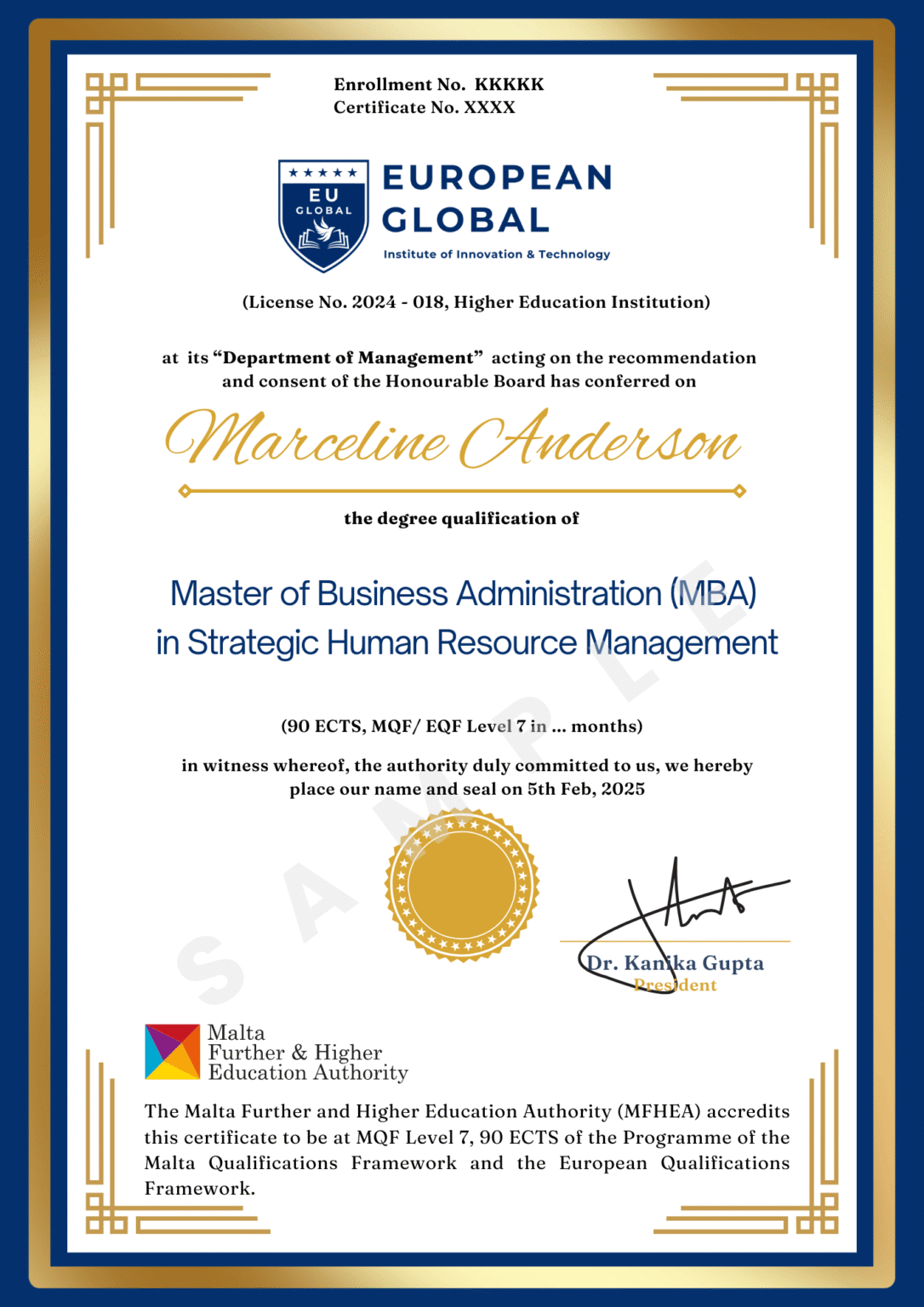

MBA in Strategic Human Resource Management
Done is better than Perfect!
Master of Business Administration (MBA) in Strategic Human Resource Management is a 90 ECTS, Level 7 Masters degree Higher Education Programme as per the European Qualifications Framework (EQF), Europe.
EU Global accepts both experiential Recognition of Prior Learning (RPL) and credit transfer through the use of learning outcomes for either an advanced entry into the programme, or module exemptions for an advanced progression in a programme.
This programme is delivered in 100% Online mode, enabling learners to develop advanced expertise in strategic human resource management while balancing professional and personal commitments globally.
Evidence-Based Learning for HR Leaders
Master of Business Administration (MBA)
Strategic Human Resource Management
EQF Level 7 • 90 ECTS Credits
Online • Globally Recognised
Programme Accreditation & Global Recognition












Programme Overview
Programme Overview EU Global MBA in Strategic Human Resource Management (SHRM) is increasingly relevant in today’s dynamic business landscape, where organisations emphasise aligning HR functions with long-term corporate goals. Research shows that companies with strategic HR management practices see a 21% higher profitability and 17% greater employee productivity than those without them. Read More
Curriculum And Structure
EU Global follows a few unique concepts for teaching its MBA students. These are:
- Evidence-based Management
- Reflective writing
- Research and Academic Coaching
- Professional Coaching
EU Global Master of Business Administration begins with Period 0 where the basics are taught that helps to make of the entire tenure of studies. Post the foundation, the learners study in modular manner to study and research on one module at one time.
Exit Awards/Qualifications
Post Graduate Diploma in Strategic Human Resource Management is available as an exit award for those who complete 60 ECTS and Post Graduate Certificate in Strategic Human Resource Management is available as an exit award for those who complete 30 ECTS.
Assessments
EU Global follows continuous and end of the module assessment. Continuous assessment counts towards the final grades.
The nature of final assessment is the report submission. The report can be a project, analysis, case study, research paper, etc.
Grading system can be accessed via Quality Policies in Download section
Target Learners Age
- Ages 19 – 30
- Age 31 – 65
Programme Overview
×EU Global MBA in Strategic Human Resource Management (SHRM) is increasingly relevant in today’s dynamic business landscape, where organisations emphasise aligning HR functions with long-term corporate goals.
Research shows that companies with strategic HR management practices see a 21% higher profitability and 17% greater employee productivity than those without them. This program equips HR professionals with critical leadership, analytics, and decision-making skills, enabling them to address complex organisational challenges such as talent acquisition, employee retention, and diversity management. With the rise of automation, 67% of executives cite the need for HR leaders to contribute to digital transformation strategies. Additionally, companies with strong HR strategies are 2.3 times more likely to outperform competitors in terms of innovation.
EU Global MBA SHRM offers professionals the tools to implement data-driven HR solutions and align workforce strategies with broader organisational objectives, making them pivotal to driving organisational success and sustainability.
Learning Outcomes
Competences
After the end of the programme, the learners will be able to:
- PA1: Critically evaluate complex and ambiguous business scenarios integrating interdisciplinary approaches to formulate strategic decisions with limited information.
- PA2: Tackle dynamic business environments, in particular related to strategic human resource management by establishing criteria, formulating innovative courses of action, implementing adaptive strategies, and evaluating results in uncertain conditions with limited information.
- PA3: Demonstrate leadership and team-building skills within complex multicultural settings, effectively managing conflict resolution and stakeholder engagement, in particular related to strategic human resource management.
- PA4: Direct self-driven learning and professional development through reflective insights, applying research-based innovations to solve emerging challenges in the strategic human resource management field.
- PA5: Benchmark strategic objectives, mentor teams, monitor performance, and lead continuous improvement in diverse business contexts, ensuring best practices relevant to strategic human resource management.
- PA6: Navigate ethical dilemmas involving conflicting stakeholder demands and cross-border business complexities, ensuring compliance with ethical and corporate governance standards relevant to strategic human resource management.
- PA7: Conduct rigorous business and management research, critically reviewing literature, applying advanced research methods, and contributing findings to professional practice within the strategic human resource management field.
Note: PA1-4 will be required to achieve the diploma exit, PA1-7 will be required for a complete Masters degree (please refer exit awards for details)
Knowledge Outcomes
After the end of the programme, the learners will be able to:
- PB1: Critically evaluate the impact of contextual forces on organisations including legal systems; ethical, economic, environmental, social and technological change issues; international developments; corporate governance and the contemporary business and management functions.
- PB2: Integrate multidisciplinary approaches to finance and accounting, including technology, ethical implications, and data analytics, for comprehensive financial decision-making to ensure the success of every project in strategic human resource management and the overall organisation.
- PB3: Critically examine and evaluate the importance of effective strategic human resource management, incorporating multidisciplinary approaches such as technology, ethical considerations, and data analytics, to optimize workforce management and enhance organizational performance.
- PB4: Develop and implement business policies and strategies in the strategic human resource management field or general management and leading perspective that adapt to changing market conditions, stakeholder interests, and emerging trends, employing specialized and multidisciplinary theoretical and practical knowledge, some of which is at the forefront of the strategic human resource management field.
- PB5: Critically analyse and innovate production and marketing processes, employing advanced problem-solving techniques to optimize business operations and critically appraising decision making relevant to strategic human resource management.
- PB6: Formulate and adapt business frameworks that anticipate market trends, organizational shifts, and emerging industry challenges, particularly in the strategic human resource management field.
- PB7: Critically review literature, apply research methods, and leverage derived specialized or multidisciplinary theoretical and practical knowledge to create and adapt innovative frameworks that are at the forefront of the business studies within the strategic human resource management field.
- PB8: Evaluate and apply ethical leadership principles, corporate governance frameworks, and sustainability strategies to ensure responsible business practices and positive social impact, especially in the strategic human resource management field.
- PB9: Synthesize and integrate specialized domain knowledge within the strategic human resource management field to address field-specific challenges and opportunities.
Note: PB1-7 will be required to achieve the diploma exit, PB1-9 will be required for a complete Masters degree (please refer exit awards for details)
Skills Outcomes
Learning Outcomes for Skills obtained at the end of the programme
The learner will be able to:
- PC1: Critically evaluate and synthesize complex, multidisciplinary data, transforming raw information into actionable insights while demonstrating awareness of social, cultural and environmental impact of their decision-making related to the strategic human resource management field.
- PC2: Apply advanced quantitative and qualitative research methods to critically analyze and evaluate business challenges, producing original research and deriving data-driven conclusions in dynamic and evolving environments related to the strategic human resource management field.
- PC3: Effectively communicate, comprehend, and conclude based on research-driven insights, demonstrating leadership in stakeholder engagement, negotiations, and decision-making across diverse professional settings.
- PC4: Exercise innovation, adaptability, and strategic foresight in professional and personal development, fostering continuous learning, leadership excellence, and the ability to respond to emerging knowledge and techniques to strategize actions for competitive advantage.
- PC5: Lead high-performance teams by fostering collaboration, critical evaluations, and transformative decision-making, demonstrate leadership skills and innovation in complex and unpredictable work environments relevant to the strategic human resource management field.
Note: PC1-2 will be required to achieve the diploma exit, PB1-5 will be required for a complete Masters degree (please refer exit awards for details)
Boost Your Portfolio with Evidence-Based Learning
EU Global’s unique teaching andragogy of evidence-based management allows learners to practice, recommend and reflect for continuous professional growth.
EU Global provides the following in addition to the content:
- Research Residency
- Entrepreneurship Residency
- Professional Coaching
- Academic Coaching
- 1:1 Project Mentor
Make the best of your MBA!