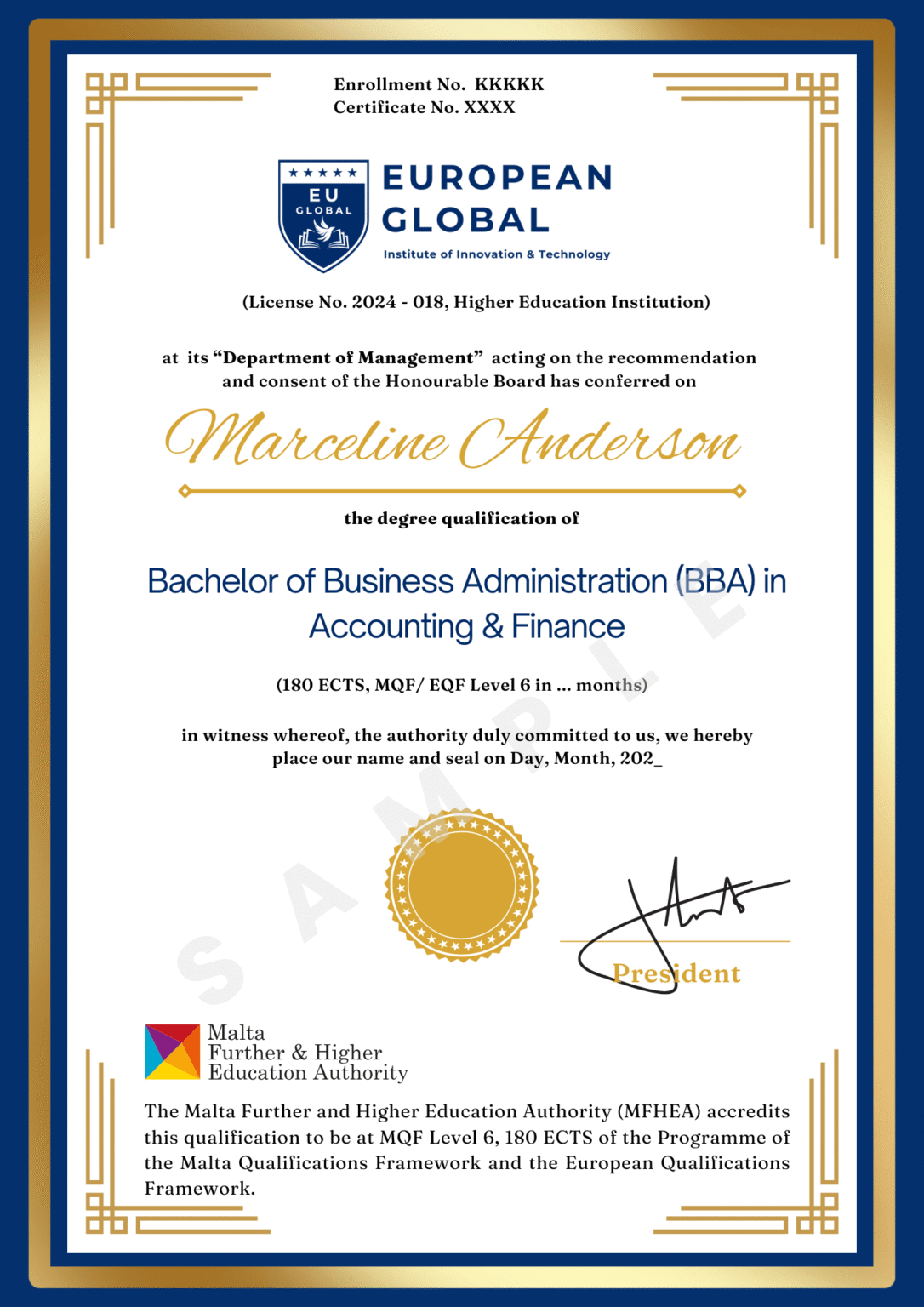

Bachelor of Business Administration (BBA) in Accounting & Finance
The Bachelor of Business Administration (BBA) in Accounting & Finance at European Global Institute of Innovation & Technology (EU Global) is a 180 ECTS, European Qualifications Framework (EQF) Level 6 Bachelor degree programme accredited by the Malta Further & Higher Education Authority (MFHEA) and globally recognised.
The programme equips learners with essential knowledge in accounting and finance, covering financial reporting, management accounting, auditing, taxation, corporate finance, investment analysis, and financial decision-making. Students develop analytical, ethical, and professional competencies applicable across global financial and business environments.
EU Global accepts Recognition of Prior Learning (RPL) and credit transfer based on learning outcomes, enabling advanced entry or module exemptions for accelerated progression. Students may also exit with recognised intermediate qualifications at 60 or 120 ECTS.
Build Expertise for Global Accounting & Finance Careers
Bachelor of Business Administration in Accounting & Finance | EQF Level 6
180 ECTS • Online • Evidence-Based Learning
Programme Accreditation & Recognition












Programme Overview
The Bachelor of Business Administration (BBA) in Accounting & Finance program equips students with essential skills in financial management, accounting practices, and economic analysis. The curriculum covers key areas such as financial reporting, auditing, taxation, corporate finance, and investment analysis. Students learn to analyse financial data, prepare financial statements, and develop strategic financial plans. Read More
Curriculum And Structure
- Evidence-based Management
- Reflective writing
- Research and Academic Coaching
- Professional Coaching
EU Global Bachelor of Arts in Business Administration begins with Period 0 where the basics are taught. Post the foundation, the learners study in a modular manner to study and research on one module at one time.
Exit Awards / Qualifications
After successful completion of either 60 ECTS or 120 ECTS, students can opt to exit the Bachelor programme and be awarded:
Undergraduate Higher Diploma in Accounting & Finance
(EQF Level 5 – 120 ECTS)
Assessments
EU Global assessment includes formative and summative assessments. Formative assessments allow learners to seek feedback and prepare for summative assessments.
Summative assessments may be categorised in continuous or end-of-module assessments. The nature of the end-of-module assessment is report submission such as a project, analysis, case study, or research paper.
Grading system can be accessed via Quality Policies in the Download section.
Target Learners Age
Ages 16 – 30
Ages 31 – 65
Programme Overview
×The Bachelor of Business Administration (BBA) in Accounting & Finance program equips students with essential skills in financial management, accounting practices, and economic analysis. The curriculum covers key areas such as financial reporting, auditing, taxation, corporate finance, and investment analysis.
The programme emphasises practical application through case studies, internships, and projects, providing real-world experience. Graduates are prepared for careers in accounting, finance, and related fields, with a strong foundation to pursue professional certifications such as CPA or CFA. The programme fosters analytical thinking, ethical standards, and effective financial decision-making.
Learning Outcomes
Bachelor of Arts in Accountancy and Finance
| a | Critically reflect on various departments and their functions within an organisation. |
| b | Critically analyse effective organisational structures and workplace culture. |
| c | Assess and discuss the importance of effective leadership styles and techniques. |
| d | Critically assess the importance of finance, human resources, marketing, strategy, and operations within organisations. |
| e | Identify the importance of effective teamwork to ensure organisational success. |
| f | Reflect on the importance of ethical considerations in business. |
| g | Critically analyse how economics influences decision-making within organisations. |
| h | Assess the importance of promoting sustainable business practices. |
| i | Identify the importance of strategy and strategic goals in organisations. |
| j | Critically assess research methods and data analysis approaches in business. |
| k | Critically analyse the role of communication in organisational success. |
| l | Assess traditional and digital marketing practices. |
| m | Reflect on the importance of investment and risk management in finance. |
Skills Outcomes
Learning Outcomes for Skills obtained at the end of the programme
| a | Critically reflect on organisational departments with special emphasis on finance. |
| b | Critically analyse organisational structures and workplace culture. |
| c | Assess effective leadership styles and techniques. |
| d | Critically assess the role of finance, HR, marketing, strategy, and operations. |
| e | Identify the importance of teamwork for organisational success. |
| f | Identify the importance of strategy and strategic goals. |
| g | Reflect on investment and risk management in finance. |
| h | Identify the role of financing and accounting within organisations. |
| i | Reflect on financial planning and control. |
| j | Assess the importance of financial reporting. |
| k | Reflect on principles and practices of taxation. |
| l | Identify auditing and assurance practices in finance and accounting. |
Boost your portfolio with Evidence-based Learning
EU Global unique teaching Andragogy of evidence-based management allows learners to practice, recommend and reflect for continuous growth.
EU Global provides following in addition to the content:
- Research Residency
- Entrepreneurship Residency
- Professional Coaching
- Academic Coaching
- 1:1 Project Mentor
Make the best of your Business Studies!